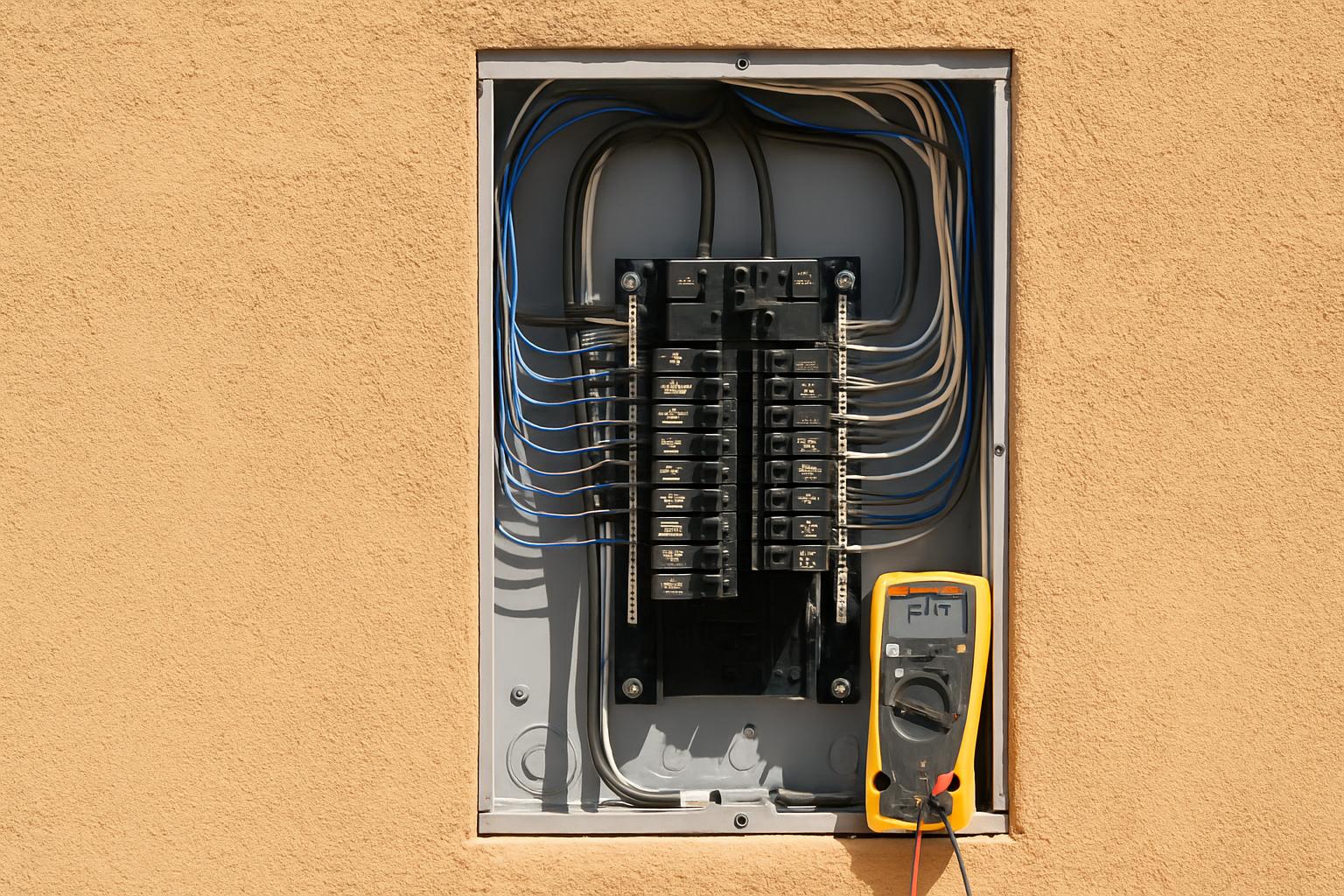
Electrical work is the home trade where the gap between a competent professional and a confident amateur is least visible and most expensive. A bad paint job announces itself. A bad splice in a junction box sits behind drywall for eleven years and then starts a fire.
Phoenix adds two specific complications on top of that. The first is age: a large share of the Valley's housing stock went up during rapid postwar growth spurts, and certain years produced materials that need attention now. The second is heat. Electrical systems are rated with an assumed ambient temperature, and a Phoenix attic in July is well outside what most of the country's installers ever think about.
Verify the License First — Arizona Makes It Easy
Arizona licenses contractors through the Registrar of Contractors (ROC), and the ROC maintains a free public license search. Before you let anyone touch a panel, look up the license number they gave you and confirm four things.
The license is active. Not expired, not suspended, not revoked.
The classification is right for the work. Residential electrical work falls under the CR-11 classification; commercial electrical is C-11; a dual license covers both. A general contractor's license is not an electrical license. A "handyman" registration is not an electrical license.
The bond is in place. Arizona requires licensed contractors to maintain a bond, and the amount scales with volume of work. The ROC record shows it.
The complaint history. The ROC record shows citations and disciplinary actions. One resolved complaint over a decade is background noise. A recurring pattern, or a license that has been suspended and reinstated more than once, is a pattern.
Two Arizona-specific points that are genuinely useful:
The handyman exemption has a dollar limit. Arizona allows unlicensed work only when the total contract — labor and materials combined — falls under a modest threshold, currently $1,000, and only when the job does not require a building permit and is not part of a larger project split up to stay under the cap. Any real electrical work will require a permit and will therefore require a license. Someone quoting you $900 cash to move a subpanel is not operating legally.
The Residential Contractors' Recovery Fund only covers licensed contractors. Arizona maintains a fund that can compensate homeowners who suffer damages from a licensed residential contractor's bad work, up to a statutory cap. Hire someone unlicensed and you have no access to it at all. This is the most concrete reason to care about license status in this state: it's not paperwork, it's your only backstop.
The Wiring Issues Specific to Phoenix Housing
Aluminum branch circuits, roughly 1965 to 1973. During a copper price spike in the mid-1960s, builders across the country wired homes with solid aluminum branch-circuit conductors. That period overlaps almost perfectly with a major Phoenix building boom, which means a meaningful number of homes in the older ring suburbs — parts of Maryvale, Sunnyslope, Arcadia's older blocks, central Phoenix, older Tempe, Mesa, and Glendale tracts — still have it.
Aluminum itself isn't the problem. The problem is the connections: aluminum expands and contracts more than copper under load, it oxidizes into a resistive layer, and it creeps under a screw terminal until the connection loosens. Loose connections generate heat. The CPSC has found homes with aluminum branch wiring to be substantially more likely to develop conditions for a fire hazard at outlets than comparable copper homes.
What to know about remediation: the two repair methods with genuine engineering support are COPALUM crimp connectors, which permanently cold-weld a copper pigtail to the aluminum conductor and require a special tool and a certified installer, and AlumiConn connectors, a set-screw lug approved as an alternative. Simply swapping devices for CO/ALR-rated receptacles and switches is a partial measure, and pigtailing with ordinary wire nuts — even "purple" ones — is not considered an adequate repair by the CPSC. If an electrician shrugs at your aluminum wiring, get another electrician. If one wants to rewire the whole house before diagnosing anything, get a second opinion on that too.
Federal Pacific Stab-Lok and Zinsco panels. Both were installed widely in the same era and both have well-documented histories of breakers that fail to trip under fault conditions. There is no repair; the answer is replacement of the panel. An electrician who identifies one of these and explains it plainly is doing you a favor, not upselling you.
What the Heat Does
This is the part out-of-state electricians get wrong.
Conductor ampacity is derated for temperature. The National Electrical Code assigns conductor ampacity at an assumed ambient, and requires correction factors as ambient temperature rises. A Phoenix attic can run 140 to 160 degrees in summer, and rooftop conduit in direct sun runs hotter still — the Code includes an explicit adder for conduit installed above a rooftop. A circuit sized by the table with no correction applied is undersized for this climate. Ask how they sized it.
Condensers and heat pumps are the biggest load in the house. Nearly every Phoenix home's electrical system is designed around air conditioning, and when a system is replaced with something larger, or a second system is added, the branch circuit and sometimes the service need to be re-evaluated. A properly done AC replacement includes verifying the disconnect, the breaker size against the equipment nameplate maximum overcurrent protection, and the conductor.
Panel and service upgrades are increasingly driven by added load: EV chargers, heat pump conversions, pool equipment, casita additions, and rooftop solar. If you're adding any of those, the first question is whether the existing service can carry it, and the answer comes from a load calculation, not a guess.
Permits
The City of Phoenix and the surrounding municipalities require electrical permits for new circuits, panel replacements, service upgrades, and most rewiring. Permits mean an inspection, and an inspection is the only independent check on the work you're paying for.
The contractor should pull the permit. In most jurisdictions the permit holder carries responsibility for code compliance — if an electrician asks you to pull an owner-builder permit for work they're performing, they are moving liability onto you, and in Arizona that arrangement can also be a licensing violation. Decline it.
Pricing Norms
Phoenix pricing moves with demand, and demand peaks in summer. Rough bands for the Valley:
Service call or diagnostic fee: commonly $75 to $150, sometimes waived if you proceed with the repair. Ask whether it's applied to the work.
Hourly labor: roughly $100 to $180 per hour for a licensed electrician, higher for after-hours and emergency calls. Many larger shops use flat-rate pricing books instead — a fixed price per task regardless of time. Flat rate isn't a scam; it protects you from a slow tech and protects them from a hard job. Just know which model you're being quoted under, and get the number before work starts.
Common jobs, as ballparks: a standard receptacle or switch replacement is an hour of labor; adding a dedicated 20-amp circuit typically runs a few hundred dollars depending on the run; a Level 2 EV charger install commonly falls between roughly $600 and $2,000 depending on distance from the panel and whether a load management device is needed; a panel replacement in the same location commonly runs a few thousand; a full service upgrade to 200 amps runs higher still and involves coordination with the utility, which adds calendar time.
Get the estimate in writing, with the scope described in enough detail that a stranger could tell whether it was completed. Be wary of a large deposit — materials for most residential electrical work are not expensive enough to justify paying half up front.
Where to Look
Licensed electrical shops are distributed across the Valley rather than clustered, and most will travel across the metro. In practice, response time is better when you hire someone whose shop is on your side of town — a West Valley company servicing Gilbert is going to price the drive in, one way or another. Older-home specialists tend to concentrate around the central corridor and the historic districts, where the work is; production-oriented shops cluster along the newer growth edges in the Southeast Valley and the far West Valley.
Looking for a licensed electrician near you in Phoenix? Browse our directory of local electrical contractors and home service companies with addresses and contact information.