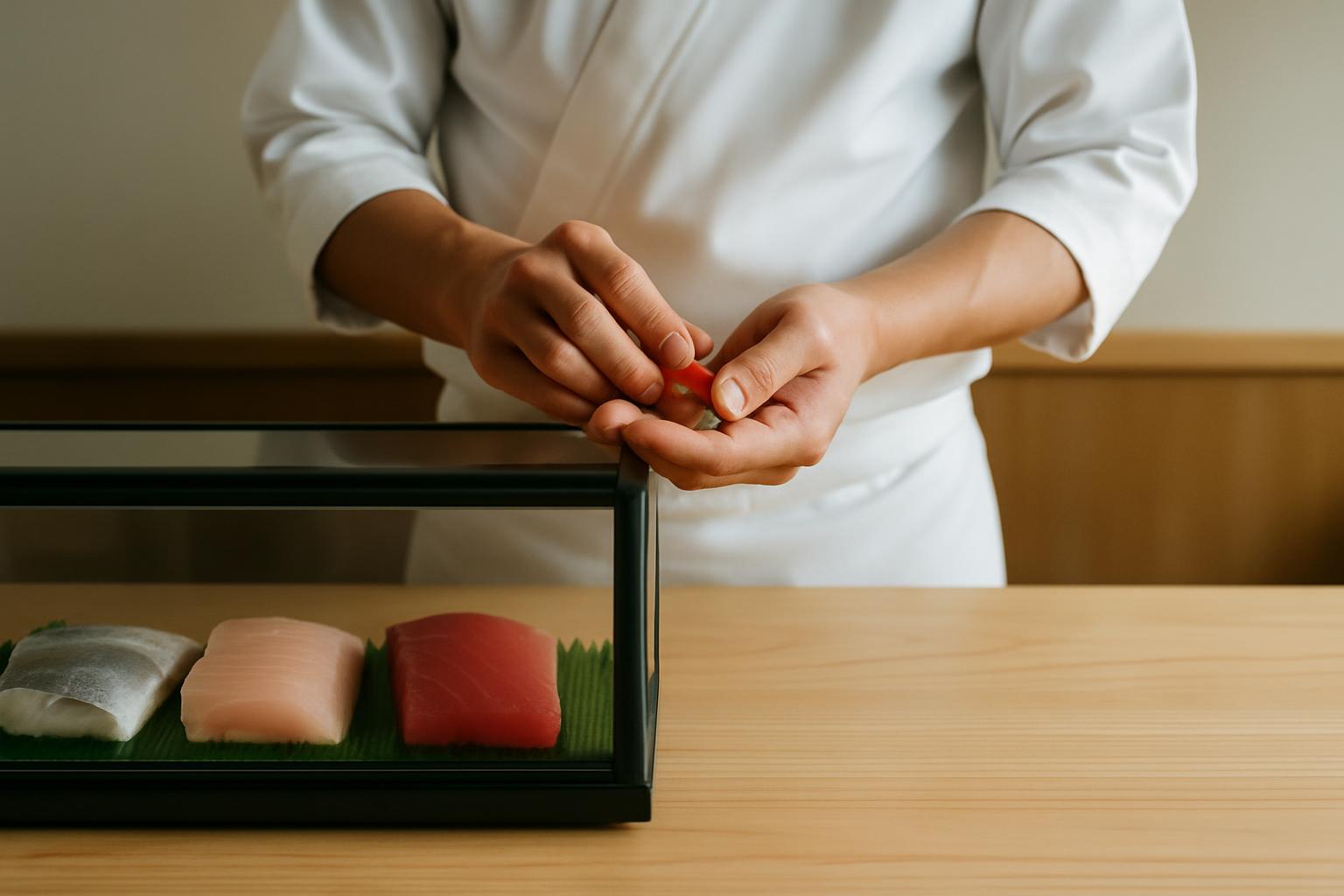
San Francisco has an unusual sushi market. It sits on a cold-water coast with serious local fisheries, it has a century-old Japanese American community, it has enough disposable income to support counters charging three hundred dollars a person, and it has a very large number of restaurants selling fifteen-dollar rolls with cream cheese in them. All four of those things are legitimately part of the city's sushi scene, and confusing one for another is how people end up disappointed at either end of the price range.
The useful skill is not knowing which restaurant is best. It's being able to walk into a room, look at the case, look at the rice, listen to how the chef answers one question, and know within five minutes what kind of place you're in.
Edomae Is a Technique, Not a Price Point
Modern nigiri comes out of early-19th-century Edo — Tokyo — where it began as fast street food made from fish caught in Tokyo Bay. There was no refrigeration, so the fish was preserved: marinated in soy (zuke), cured in kelp (kombu-jime), salted and vinegared (shime), simmered in a sweet reduction (nitsume), or lightly poached. Those treatments weren't garnishes. They were the point.
That tradition is what people mean by edomae. A counter working in that lineage is doing things to the fish before it reaches you: aging tuna for days to develop flavor, curing mackerel, brushing each piece with nikiri (a soy-and-mirin glaze) so you never touch the soy dish, warming the rice to near body temperature, and seasoning the rice with enough salt and vinegar — often red vinegar, akazu, which turns the rice a light tan — to stand against the fish.
The rice tells you more than the fish does. At a serious counter, shari arrives slightly warm against cool fish, seasoned assertively, and the grains separate on the tongue rather than arriving as a compressed block. Cold, bland, dense rice is the single most common failure in American sushi, and it's the one that costs the least to fix and gets fixed the least.
None of this means Americanized rolls are illegitimate. A well-made spicy tuna roll is a good thing, and California's contribution to sushi history is real. It's just a different food, and it should be priced like one.
Omakase Price Tiers in This City
Under roughly $80 per person. Usually a set course rather than true chef's choice, often at lunch, frequently very good value. Expect farmed and widely available species, less aging, and a faster pace. Many neighborhood counters do a lunch omakase at a fraction of their dinner price using the same fish.
Roughly $120 to $200. The broad middle of San Francisco's serious counters. Fifteen to twenty courses, a mix of imported Japanese fish and local catch, real knife work, a chef who talks to you. This is where most of the city's value sits.
$250 and up. Small counters, often eight to twelve seats, two seatings a night, heavy on airfreighted Japanese product, aged tuna, seasonal specialties, and a rigid reservation system that opens on a fixed day each month. At this tier you are paying for sourcing and scarcity as much as skill.
A few things that are true across tiers: substitutions and heavy customization are discouraged at a counter and fine at a table. Drinks are frequently not included and can add substantially. Service charges in San Francisco restaurants are common and often itemized separately from tip — read the bottom of the menu before you order, because a listed price can land twenty-five percent higher than you expected once mandated surcharges and tax are applied.
How to Read a Fish Case
Not every good counter has a display case — many high-end rooms keep fish in covered wooden boxes precisely because air and light are the enemy. But where there is a case, it's readable.
Tuna should be a deep, even red with no iridescent rainbow sheen. That shimmer is a light-diffraction effect on cut muscle fiber and, while it isn't automatically a spoilage sign, it tends to show up on fish that's been sitting cut. Be more skeptical of tuna that is uniformly bright, unnaturally pink-red — that appearance can come from carbon monoxide or "tasteless smoke" treatment, which fixes the color of the myoglobin so the flesh stays red long after it would otherwise dull.
Whitefish should look translucent and firm, not chalky or weeping.
Liquid in the case is the clearest bad sign. Pooling fluid means cells have ruptured, usually from freeze-thaw cycling or age.
Whole fish and unbroken loins are a strong positive. A kitchen breaking down its own fish has control over the product; a kitchen receiving pre-cut saku blocks does not.
Also worth knowing: "sushi grade" is not a regulated term in the United States. It means whatever the seller wants it to mean. What is regulated is the FDA's guidance that fish intended for raw consumption be frozen under specified time-and-temperature conditions to kill parasites, with narrow exceptions for certain tuna species and for aquacultured fish raised on parasite-free feed. So the fact that your fish was frozen is normal, correct, and not a knock on quality. Flash-frozen at sea and properly thawed beats "fresh" that spent four days in transit.
Sourcing and Sustainability Claims
The Bay Area is where the Monterey Bay Aquarium's Seafood Watch program is based, and its ratings are the most commonly cited standard in Northern California restaurants. A counter that references specific ratings, names its suppliers, or tells you which boat the local halibut came from is at least engaged with the question.
Certification marks worth recognizing: MSC (blue label) for wild-capture fisheries and ASC for farmed. Both are third-party audited; neither is perfect.
Bluefin is the one to think about. Pacific bluefin stocks were severely depleted and have been under rebuilding plans; some fisheries have improved markedly and some sourcing remains problematic, and the answer genuinely depends on the stock and gear type. A chef who can tell you where their bluefin came from is a chef who is paying attention. One who can't, isn't.
Local and seasonal is the more interesting angle anyway. Northern California produces excellent halibut, sablefish, rockfish, Dungeness crab in winter, sea urchin from the Mendocino and Santa Barbara coasts, and squid. Counters that build even part of the menu around what's landing locally tend to be the more thoughtful ones.
Where the Counters Cluster
Japantown, around the Post and Buchanan blocks in the Western Addition, is the historic center and holds everything from casual counters and izakaya to serious sushi. It is also the most concentrated place in the city to eat Japanese food that isn't sushi at all.
The Inner Richmond, especially the Clement Street corridor, is the best value density in San Francisco — neighborhood counters serving a residential population that eats there constantly, at prices well below downtown.
The Financial District, SoMa, and the Embarcadero hold the expense-account omakase rooms. Excellent technique, high prices, and reservation systems that reward planning.
The Mission and the Castro mix modern counters, fusion-leaning kitchens, and a handful of very good small omakase rooms tucked into unassuming storefronts.
The Marina, Cow Hollow, and Pacific Heights skew toward scene-driven rooms where the crowd is part of the product. Some genuinely good sushi here; read carefully.
The Sunset, along Irving and Noriega, is the other great neighborhood-value corridor, and it's where you'll find the most casual, least performative counters in the city.
Practical Notes
Sit at the counter if you can. Order nigiri rather than rolls when you're evaluating a place, and start with something plain — a whitefish, or the egg — because there's nowhere to hide. Eat each piece within a few seconds of it being placed; the chef timed the rice temperature for that moment. Don't drown anything in soy, and don't put wasabi in the soy dish at a counter where the chef is already seasoning each piece. Book serious omakase rooms well ahead, and check whether the deposit is refundable. And if you want one honest question that sorts rooms quickly, ask what's good today. A chef with an answer is a chef who went to the market.
Looking for sushi near you in San Francisco? Browse our directory of local sushi restaurants and Japanese kitchens with addresses, hours, and directions.