Fall maintenance is mostly an exercise in scheduling. Nearly every job on the list is cheap, quick, and uneventful in September, and expensive, urgent, and miserable in December. The furnace tune-up that costs $120 on a Tuesday in early October costs $350 as an emergency no-heat call on the first hard freeze, if anyone can come at all.
The other half of the problem is knowing who to call. Homeowners routinely call a plumber for a job that belongs to an HVAC technician, or an HVAC company for something a chimney sweep handles. The right trade on the first call saves a diagnostic fee and a week.
Book These in Late August or Early September
Heating system service — call an HVAC contractor. The most important item here and the one with the worst queue dynamics. Every HVAC company in a cold climate gets buried the week temperatures first drop, and you want to find a problem while parts are available.
A real tune-up is not a wipe-down. It should include a heat exchanger inspection for cracks — on a gas furnace this is the safety-critical item, since a cracked exchanger can put combustion byproducts into your living space — plus a burner and flame inspection, draft and venting check, gas pressure verification, blower cleaning and amp draw, flame sensor cleaning, safety control testing, filter replacement, and static pressure measurement. Ask for the readings in writing. A visit that produces no numbers produced nothing. Expect roughly $90 to $200, more for a boiler, which has its own checklist.
While you're at it, test every smoke and carbon monoxide alarm and replace any unit past its service life. CO alarms typically last five to seven years and expire silently.
Chimney and fireplace — call a chimney sweep, ideally CSIA-certified. The Chimney Safety Institute of America credential is the recognized one in this trade. October and November are a sweep's busiest months; September is when you can actually get one.
A Level 1 inspection covers readily accessible portions of a system in continued use with no changes. A Level 2 adds video scanning of the flue interior and is called for after a chimney fire, after a weather event, when you change fuel or appliances, and at property transfer. Expect roughly $150 to $400 for an inspection and sweep of a standard masonry fireplace.
They're looking for creosote buildup — the third stage is a hard glaze that ordinary brushing will not remove and that requires chemical treatment or specialized tooling — plus liner condition, crown cracks, a missing or damaged cap, roof flashing, and animal nests. Gas fireplaces and log sets need annual service too, usually from a hearth technician rather than a sweep.
Irrigation blowout — call an irrigation contractor. Anywhere that freezes, water left in sprinkler lines will split PVC and destroy backflow assemblies and valves. The job is straightforward — isolate the system and push compressed air through zone by zone until the heads run dry — but pressure matters: too much air destroys the fittings it's meant to protect, and the safe ceiling is low, generally well under 80 PSI depending on pipe material.
Expect $75 to $150 for a typical residential system. Schedule for a few weeks before your average first hard freeze and book in early September, because everyone in town needs the same two-week window.
Snow removal contracts, if you use one — call a landscaping or snow service. These are priced and filled in early fall. Per-push costs less in a mild winter; a seasonal flat rate is insurance against a bad one.
Book These in September or October
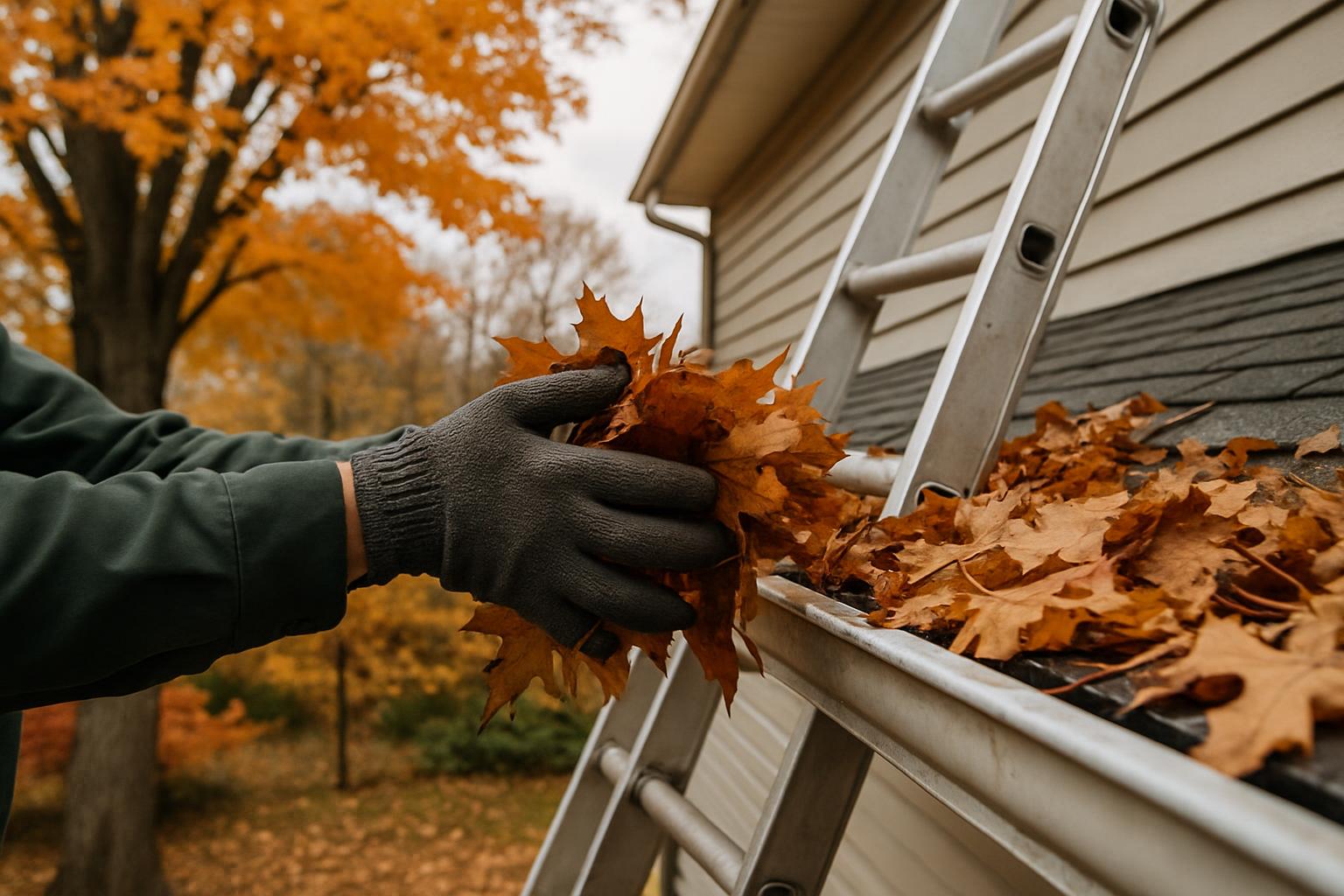
Gutters — call a gutter cleaning or roofing company. Clean after the leaves finish falling, not before, or you'll pay twice. Expect $100 to $250 for a single story and $200 to $450 for two, more for steep roofs or gutter guard removal.
Two things matter more than the cleaning. Downspout extensions should carry water four to six feet from the foundation; a clean gutter that dumps at the footing is a wet basement waiting to happen. And ice dams are not a gutter problem — they're caused by heat escaping into the attic, melting snow up high, which refreezes at the cold eave. The fix is air sealing and insulation, which is an insulation contractor or energy auditor, not a gutter company.
Roof inspection — call a roofing contractor. A pre-winter look at flashing, pipe boots, valleys, and anything around a chimney or skylight. Pipe boots crack from UV exposure and are the most common small leak source in the country. Many roofers will look for free or a modest fee in fall.
Tree work — call an ISA Certified Arborist. The trade where hiring badly is most dangerous. Two credentials matter: ISA Certified Arborist for the individual, and TCIA accreditation for the company.
Insurance verification is non-negotiable here. Tree work generates enormous liability, and you want general liability and workers' compensation certificates sent directly from the insurance agent.
What to have done before winter: remove deadwood and hanging limbs, clear branches overhanging the roof and the service drop, and address trees with visible structural defects — co-dominant stems with included bark, large cavities, fungal conks at the base, a recent lean. Snow and ice load is what turns a weak union into a hole in your roof.
What not to have done: topping. Cutting a crown back to stubs is a discredited practice that produces weak regrowth, invites decay, and shortens the tree's life. An arborist who proposes it is not an arborist.
Typical pruning on a mature tree runs $400 to $1,500; removals range from around $500 for a small tree to well over $3,000 for a large one near structures. Emergency post-storm work costs multiples of scheduled work, which is the argument for doing it now.
The Shorter, Cheaper Items
Dryer vent cleaning — a dryer vent or duct specialist, roughly $100 to $200. Lint in the line is a real fire cause.
Water heater flush and anode check — a plumber, $100 to $250. The anode rod is a sacrificial component that corrodes so the tank doesn't; on a tank over four or five years old it's worth pulling and inspecting. Tankless units need periodic descaling instead.
Outdoor faucets — yourself, or a plumber. Disconnect every hose. A hose left on a frost-free sillcock traps water in the valve body past the freeze point and defeats the entire design, which is the most common cause of a burst pipe behind an exterior wall.
Sump pump test — pour a bucket into the pit, confirm it runs and shuts off, and check that the discharge line isn't blocked or aimed somewhere that will freeze. If basement flooding would be costly, add a battery backup: outages and heavy water arrive together.
Septic pumping — a septic service, every three to five years, roughly $300 to $600. Do it before the ground freezes.
Air sealing and insulation — start with a blower door test from a BPI- or RESNET-credentialed energy auditor. It measures actual leakage and finds where it is, so you seal the right things rather than the visible ones. Many utilities subsidize or fully cover the audit.
Lead Times and a Pricing Note
Roughly: HVAC, chimney sweeps, and irrigation contractors book four to six weeks out in peak season and can be same-week in early September. Arborists run weeks to months out and become effectively unavailable after a storm. Gutter and roofing availability collapses with the first bad weather. Plumbers stay reachable but charge emergency rates the day pipes freeze — the same day everyone else's pipes freeze.
Off-season is cheaper partly because the crew isn't triaging, so you get better work and not just a better price. But be wary of the very cheap inspection that exists to sell you something: a $49 furnace tune-up from a company advertising heavily is frequently lead generation, and the technician's job is to find a reason to quote a system. Ask to be shown the problem, ask for the measurements, and get a second opinion on any recommendation to replace rather than repair a system under fifteen years old.
Finally, write down what you did and when. A one-page record of service dates, filter sizes, and who you called turns next fall's list into twenty minutes of phone calls.
Looking for a contractor near you? Browse our directory of local home service businesses by trade and city, with addresses and contact information.